 |
Matronics Email Lists
Web Forum Interface to the Matronics Email Lists
|
| View previous topic :: View next topic |
| Author |
Message |
richard.beebe(at)yale.edu
Guest
|
 Posted: Wed Nov 12, 2014 8:58 am Post subject: lithium facts Posted: Wed Nov 12, 2014 8:58 am Post subject: lithium facts |
 |
|
I'm responding to a couple different bits of this thread here.
On 11/08/2014 05:14 PM, Robert L. Nuckolls, III wrote:
Tesla uses Panasonic NCR18650A 3100mAh cells which are Lithium Nickel
Cobalt Aluminum Oxide (NCA). The Tesla Roadster used Lithium Cobalt Oxide.
| Quote: | I've been working on a series of articles for Kitplanes
on the use of lithium batteries in airplanes. Energetic
concerns for making the switch are centered on the extra-
ordinary ability of lithium batteries to catch fire . . .
and set other things on fire too.
|
My guess is that most of the RC and laptops that have melted down had
Lithium Cobalt Oxide batteries. They have a thermal run-away temperature
of only 150C. They also tend to get hot in use which exacerbates the
problem. LiFePo4 can go to 270C before they meltdown and they don't
generate anywhere near as much heat in operation. But they have less
energy density which isn't really that much of an issue in the case of
an aircraft or automobile 12v battery. The Boeing 787 batteries that
burned up were Lithium Cobalt Oxide. They should have taken the small
weight penalty and used LiFePo4, IMO.
| Quote: | A 3-cell lithium battery gets fully stuffed at 12.6 volts,
a 4-cell array would like to see 16.8 volts. Hmmmm . . .
what's the elegant design goal? We've read in the journals
that the hybrid car guys design their charge-discharge
profiles to operate state-of-charge over a range of 20-80%
to maximize the battery's service life. What happens if
we charge a 4-cell array at 14.4/4 or only 3.6 volts per
cell?
|
While most of the lithium chemistries are nominally 3.6-3.7 volts,
LiFoPo4 is only 3.2 volts. Most of my dealings with these cells are in
electric cars. Motive is a different use than a starting battery but
we've still learned a lot. 8 years ago the LiFoPo4 manufacturers were
saying to charge their cells to 4.2 volts and people were having a lot
of failures. They've since modified that to an upper limit of around 3.6
volts which works well when using 4 cells to build a starting battery.
Unlike your testing, in my testing of the larger format cells from CALB
I found little energy could be pushed into the cells above 3.6 volts.
The charge curve is very flat but when it hits 3.6 the voltage rises to
4 very quickly. And when I discharge the cells from 3.6 down to where
the voltage starts to fall dramatically (under 3 volts) I get pretty
much the full rated amp-hours out of them.
Specs and factory graphs of the cells I've tested are here:
http://evwest.com/support/CALB-CA100Ah.pdf
You said you were testing LiFePo4 cells and that 3.6 volts was only half
their capacity. It makes me wonder what the recipe of those cells is
because that behavior fits more with other lithium chemistries, but not
with LiFePo4. It is hard to get consistent data on lithium cells because
the manufacturers are always experimenting with the makeup of the cells
and it can sometimes have dramatic performance differences.
Other considerations for people thinking of making the switch to lithium
is that LiFePo4 doesn't like to be charged below freezing. I don't
particularly like to fly below freezing either, but I have done it. You
can discharge the cells down to -20C so starting the plane might not be
an issue but it would suck to get to your destination and discover that
the battery got fried being charged back up in the air. I have not
tested this--I put heated battery boxes in my electric vehicle.
The good thing--in addition to less weight--is almost no self-discharge.
I had 38 cells sitting in my basement for 6 months and the voltage was
the same within 2 hundredths of a volt on every cell but one. And I got
that one replaced because self-discharge is a good indicator of an
internal soft short (a piece of metal dust or other contaminate that's
conducting power between anode and cathode).
I have 2 electric vehicles and in one of them I had replaced a full-size
lead-acid battery with a garden tractor battery because I didn't need
the starting amps and wanted to save some weight. I just replaced that
one with a tiny little lithium battery from Deltran (aka Battery
Tender). It pretty much just needs to keep the radio channels set, some
instrumentation alive and provide enough urge to close the contactors
when I turn the key. It's been in two days and I'm definitely curious to
see how it stands this winter. They sell them for "motorsport" uses like
motorcycles and ATVs. Most people put their bikes away in the winter
here in New England but people do use ATVs year-round. I don't know how
those people would like these batteries but for $70 I was willing to
experiment.
--Rick
| | - The Matronics AeroElectric-List Email Forum - | | | Use the List Feature Navigator to browse the many List utilities available such as the Email Subscriptions page, Archive Search & Download, 7-Day Browse, Chat, FAQ, Photoshare, and much more:
http://www.matronics.com/Navigator?AeroElectric-List |
|
|
|
| Back to top |
|
 |
ARGOLDMAN(at)aol.com
Guest
|
| Posted: Wed Nov 12, 2014 11:29 am Post subject: lithium facts |
|
|
My head is buzzing from all the lithium that we are talking about, although I am now less bipolar.
Lessee---- If I am an aircraft with standard 12(14)V electrical system and standard charging system, what will I see and what difference will I see if I have a starved electrolyte battery vs a liFEPO4 battery. As an aircraft, I, as a dumb airplane, cannot really, nor do I want to, understand, the cell structure, charging techniques, ideal voltage etc. All I really want to know is will it start my engine and if my charging system goes TU how much time will I have available to energize my electrical system (radios, EFI, electronic ignition system, ie. just those elements on my essential buss.
I am aware, even with my airplane brain, I think that it is located somewhere in my elevator, that either battery chemistry can start my propeller propellering. and if that were the only thing I needed, I would certainly opt for the lightest battery possible. My concern is that in the case of loss of the alternator (generator if so equipped), how long will my vitals stay vital. Other than that, I really don't give a rat's tail-cone.
So lets take a non-starting, constant load of say--15A and compare a lead acid battery of a given size and a LIFEPo4 battery (Or batteries) of EQUAL weight.How long would I last with each before the energy (since being an aircraft I don't know volts from amps (I just buzz around saying OOOOOOM)) is low enough to start effecting my vitals I am going to assume that the charging method is the standard basic settings of the aircraft with the battery(s) charged to max with that system.
An additional comparison should be made LI to LI using their cell balancers and without. An additional test should be done with the charging system set for the "Ideal LiFEPOs charging voltage).
Once that figure is derived, it would be a simple matter to determine what weight (size) of the LI type would be equivalent to that of the PB variety for my selfish needs.
This is not to say that the longevity of each type of battery with the similar charging voltage is trivial.
Of course it is very easy to suggest the research, not being able nor inclined to do it myself.
I think that one or two of the Major aircraft battery manufacturers are now offering Li batteries (probably with an attached STC. My guess is that they have already done the above recommended testing.
I'm still trying to decide what kind of chemistry I will be carrying in my battery area but my builder won't have to make that decision for a while.
Respectfully submitted
Aerocanard 948RG
(Rich)
In a message dated 11/12/2014 10:59:53 A.M. Central Standard Time, richard.beebe(at)yale.edu writes:
| Quote: | --> AeroElectric-List message posted by: Rick Beebe <richard.beebe(at)yale.edu>
I'm responding to a couple different bits of this thread here.
On 11/08/2014 05:14 PM, Robert L. Nuckolls, III wrote:
Tesla uses Panasonic NCR18650A 3100mAh cells which are Lithium Nickel
Cobalt Aluminum Oxide (NCA). The Tesla Roadster used Lithium Cobalt Oxide.
| Quote: | I've been working on a series of articles for Kitplanes
on the use of lithium batteries in airplanes. Energetic
concerns for making the switch are centered on the extra-
ordinary ability of lithium batteries to catch fire . . .
and set other things on fire too.
|
My guess is that most of the RC and laptops that have melted down had
Lithium Cobalt Oxide batteries. They have a thermal run-away temperature
of only 150C. They also tend to get hot in use which exacerbates the
problem. LiFePo4 can go to 270C before they meltdown and they don't
generate anywhere near as much heat in operation. But they have less
energy density which isn't really that much of an issue in the case of
an aircraft or automobile 12v battery. The Boeing 787 batteries that
burned up were Lithium Cobalt Oxide. They should have taken the small
weight penalty and used LiFePo4, IMO.
| Quote: | A 3-cell lithium battery gets fully stuffed at 12.6 volts,
a 4-cell array would like to see 16.8 volts. Hmmmm . . .
what's the elegant design goal? We've read in the journals
that the hybrid car guys design their charge-discharge
profiles to operate state-of-charge over a range of 20-80%
to maximize the battery's service life. What happens if
we charge a 4-cell array at 14.4/4 or only 3.6 volts per
cell?
|
While most of the lithium chemistries are nominally 3.6-3.7 volts,
LiFoPo4 is only 3.2 volts. Most of my dealings with these cells are in
electric cars. Motive is a different use than a starting battery but
we've still learned a lot. 8 years ago the LiFoPo4 manufacturers were
saying to charge their cells to 4.2 volts and people were having a lot
of failures. They've since modified that to an upper limit of around 3.6
volts which works well when using 4 cells to build a starting battery.
Unlike your testing, in my testing of the larger format cells from CALB
I found little energy could be pushed into the cells above 3.6 volts.
The charge curve is very flat but when it hits 3.6 the voltage rises to
4 very quickly. And when I discharge the cells from 3.6 down to where
the voltage starts to fall dramatically (under 3 volts) I get pretty
much the full rated amp-hours out of them.
Specs and factory graphs of the cells I've tested are here:
http://evwest.com/support/CALB-CA100Ah.pdf
You said you were testing LiFePo4 cells and that 3.6 volts was only half
their capacity. It makes me wonder what the recipe of those cells is
because that behavior fits more with other lithium chemistries, but not
with LiFePo4. It is hard to get consistent data on lithium cells because
the manufacturers are always experimenting with the makeup of the cells
and it can sometimes have dramatic performance differences.
Other considerations for people thinking of making the switch to lithium
is that LiFePo4 doesn't like to be charged below freezing. I don't
particularly like to fly below freezing either, but I have done it. You
can discharge the cells down to -20C so starting the plane might not be
an issue but it would suck to get to your destination and discover that
the battery got fried being charged back up in the air. I have not
tested this--I put heated battery boxes in my electric vehicle.
The good thing--in addition to less weight--is almost no self-discharge.
I had 38 cells sitting in my basement for 6 months and the voltage was
the same within 2 hundredths of a volt on every cell but one. And I got
that one replaced because self-discharge is a good indicator of an
internal soft short (a piece of metal dust or other contaminate that's
conducting power between anode and cathode).
I have 2 electric vehicles and in one of them I had replaced a full-size
lead-acid battery with a garden tractor battery because I didn't need
the starting amps and wanted to save some weight. I just replaced that
one with a tiny little lithium battery from Deltran (aka Battery
Tender). It pretty much just needs to keep the radio channels set, some
instrumentation alive and provide enough urge to close the contactors
when I turn the key. It's been in two days and I'm definitely curious to
see how it stands this winter. They sell them for "motorsport" uses like
motorcycles and ATVs. Most people put their bikes away in the winter
here in New England but people do use ATVs year-round. I don't know how
those people would like these batteries but for $70 I was willing to ================================================nbsp; (And Get Some AWESOME FREE to find Gifts ilder's ELP k you for p; -Matt Dralle, List ======================== = Use utilities Day ================================================ - MATRONICS WEB FORUMS ==================================================
|
[quote][b]
| | - The Matronics AeroElectric-List Email Forum - | | | Use the List Feature Navigator to browse the many List utilities available such as the Email Subscriptions page, Archive Search & Download, 7-Day Browse, Chat, FAQ, Photoshare, and much more:
http://www.matronics.com/Navigator?AeroElectric-List |
|
|
|
| Back to top |
|
|
richard.beebe(at)yale.edu
Guest
|
| Posted: Wed Nov 12, 2014 1:30 pm Post subject: lithium facts |
|
|
On 11/12/2014 02:28 PM, ARGOLDMAN(at)aol.com wrote:
| Quote: | So lets take a non-starting, constant load of say--15A and compare a
lead acid battery of a given size and a LIFEPo4 battery (Or
batteries) of EQUAL weight.How long would I last with each before the
energy (since being an aircraft I don't know volts from amps (I just
buzz around saying OOOOOOM)) is low enough to start effecting my vitals
I am going to assume that the charging method is the standard basic
settings of the aircraft with the battery(s) charged to max with that
system.
Equal weight? No contest although I'm too lazy to do the math right now.
|
Here's an anecdotal answer though. I have a Ford Ranger that was
converted to electric. 144 volts with 24 215Ah lead-acid batteries. They
weighed 1600 pounds and would drive the truck about 40 miles.
I replaced them with 38 100ah lithium cells. Still 144 volts but only
weighing 347 pounds. The truck will go about 50 miles and it does it in
a much more spritely manner.
There are some interesting considerations for your test. One is that
voltage of lead-acid batteries decreases linearly with state of charge
(SOC). From roughly 12.65 volts fully charged to 11.89 volts completely
empty. At what point in that slope, though, will your electronics start
to behave erratically? I don't know. In general, for long life, you
don't want to discharge more than 50% or down to 12.24 volts.
LiFePo4 cells have a very flat discharge curve. 4 cells tied together
will be at roughly 13.2 volts full and will drop to 12.6 before suddenly
dropping to 0 as the battery reaches empty. You'd like to avoid that
drop but as far as your plane is concerned the battery will look full
for the entire discharge time which could use up almost all the capacity
of the battery.
--Rick
| | - The Matronics AeroElectric-List Email Forum - | | | Use the List Feature Navigator to browse the many List utilities available such as the Email Subscriptions page, Archive Search & Download, 7-Day Browse, Chat, FAQ, Photoshare, and much more:
http://www.matronics.com/Navigator?AeroElectric-List |
|
|
|
| Back to top |
|
|
nuckolls.bob(at)aeroelect
Guest
|
| Posted: Thu Nov 13, 2014 8:58 am Post subject: lithium facts |
|
|
So lets take a non-starting, constant load of say--15A and compare a lead acid battery of a given size and a LIFEPo4 battery (Or batteries) of EQUAL weight.
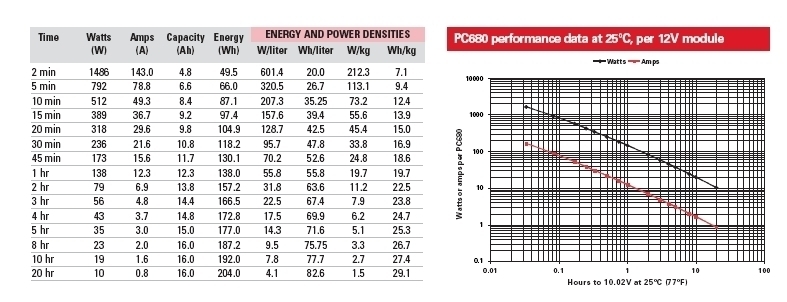
Okay, consider the PC680 which claims to offer 45 minutes
endurance when loaded to 15.6 amps for an energy delivery
value of 130 Watt-hours.
[img]cid:.0[/img]
Okay, let's do a back-of-the-envelope . . . (actually, restaurant napkins are my favorite these days - don't carry much mail around with me. Best yet, I've discovered a ball-point pen that writes on grade Z napkins without tearing them. I hand them out to my cohorts in brainstorming at lunch!) . . . back of the napkin sanity check on a DIY replacement
for a PC-680:
Referring to the specs for an A123, 25560 cell, - lifepo4 CHEMISTRY
- Nominal voltage: 3.3V
- Nominal capacity: 2.3Ah
- Core cell weight: 70 grams
- 65mm tall, 26mm diameter (same diameter as a C battery)
- Internal impedance: (1kHz AC) 8 m typical
- Typical fast charge current: 10A to 3.6V CCCV
- 70A continuous discharge
- 120A, 10 sec pulse discharge
- Cycle life at 10C discharge, 100% DOD: over 1,000 cycles
. . . they will allow very high discharge currents with a
relatively flat discharge curve so we can calculate each cell to contain
about 7.5 watt-hours of energy.
To approximate the energy content of the PC680, we would need
130/7.5 or 17 cells. We are obliged to configure these cells in
series strings of four so a 4 x 4 array of 16 cells gets
us 120 watt-hours. Okay, right in the ballpark. Further,
the 70A continuous discharge rating says the 4 parallel
strings would grunt a 280A cranking current without
breathing hard. Higher momentary loads are obviously
not out of the question.
Okay, the 4 x 4 x 26650 array would weigh in at about
1200gm plus another 400 for a case, which gives
us 1600gm (3.5 pounds with no battery management
system).
Okay, I just put the EarthX ETX36 . . . Model: ETX36D
Nominal Operational Voltage . . 13.3 V Ah (Lead-acid equivalent) . . . 36 Ah (actual) . . . . . . . . . . 12 (.5C rate) . . . Reserve Capacity . . . . . . . 27 min. Pulse Crank Amps (PCA) . . . . 680A (3 sec (at) 25 °C, voltage >9V) Cold Crank Amps (CCA) . . . . . 405A (modified SAE, 3 sec(at) 0°F, voltage >7.2V) Continuous Discharge Amps . . . 100A Standard Charge Voltage . . . . 13.9 - 14.6 V Maximum Charge Voltage . . . . 15 V Recommended Charge Amps . . . . 1 - 15A Max Charge Amps . . . . . . . . 60A (from vehicle charging system) Life (Charge cycles, 80% deep of discharge) 4000 cycles (at) 1C discharge rate, 25°C 2000 cycles (at)10C discharge rate, 25°C
Life (Years) . . . . . . . . . 8 Years Weight . . . . . . . . . . . . 3.9 lb. (1.8Kg) Dimensions ETX36D . . . . . . . 6.9 x 3.4 x 6.1 inches Environmental Ratings
Resistance to water intrusion . IP 66 (Hi Pressure wash) Operating Temperature . . . . 30 °C to +60 °C Storage Temperature . . . . . .-40 °C to +70 °C
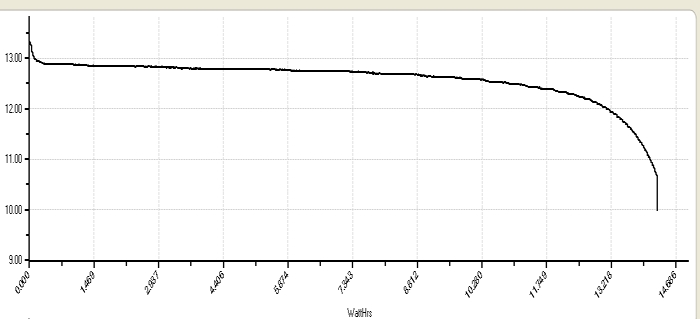
. . . on a 15A discharge with a data acquisition
system attached . . . let's see what we get.
[img]cid:.1[/img]
This product has a built-in BMS that disconnects the output if the terminal
voltage drops below a safe value for the battery . . . in this case, 10.6
volts. There was a 10x multiplier in the load current so the readings across
the bottom should be multiplied by 10. This particular test cycle terminated
at 142 watt-hours . . . right in the same ball-park as PC-680 published
data and our back-of-the-napkin DIY analysis for a 4 x 4 array of 26650 cells.
==
So from the perspective of evaluating available energy,
it appears that the ETX-36 series batteries are a drop-in
replacement for the PC-680. Both batteries demonstrate
performance in the 12AH class with a 15A load.
You get a weight differential of 14.8 - 3.9 = 10.9
pounds and a price differential of 350 - 110 = $240.
In the TC aircraft world, most manufacturer's would
be delighted to pay $24/lb for empty weight
reduction. In the OBAM aircraft world, that 10
pounds is not so 'valuable' . . . how many flights
have you re-configured because you were 10# "over
gross". Now, if the lithium battery could demonstrate
a service life of say 3x that of the SVLA, then
cost per operating hour is a wash and the weight
savings are 'free'.
Bob . . .
| | - The Matronics AeroElectric-List Email Forum - | | | Use the List Feature Navigator to browse the many List utilities available such as the Email Subscriptions page, Archive Search & Download, 7-Day Browse, Chat, FAQ, Photoshare, and much more:
http://www.matronics.com/Navigator?AeroElectric-List |
|
| Description: |
|
| Filesize: |
177.32 KB |
| Viewed: |
13351 Time(s) |
|
| Description: |
|
| Filesize: |
55.53 KB |
| Viewed: |
13351 Time(s) |
|
|
|
| Back to top |
|
|
argoldman(at)aol.com
Guest
|
| Posted: Thu Nov 13, 2014 9:09 am Post subject: lithium facts |
|
|
Greetings Rick, and all,


 My builder is familiar with the concepts and suggestions in your post, and I too am to lazy to do the math.


 In terms of the voltage drop during discharge being different for the different types of batteries, my owner is also quite famaliar with that,also. My understanding of electronics (gleaned through reading stuff--very difficult without my landing light lenses attached, is that it takes a combination of voltage and amperage to do a job. I'm still trying to figure out watts that all about.


 I do know that at a certain time in the deminishment of the stored power in a battery, no matter what the chemistry, that my gizmos willl stop gizzing and give my owner either a big "X" across the screen or false readings, or worse yet, my heart will beat incorrectly, if at all, and I may squirt various liquids inappropriately and at incorrect times. I do not know the level at which that would occur.


 I remember in a sibling that my builder also built, he had a Navaid Devices 1 axis autopilot (company now out of business). This device was actually quite good, however at about 11V the device would show a turn and attempt to correct that with aileron input. fortunately I discovered this on the ground in initial testing and after extensive testing (and wasted time) determined that to be the problem. In the air, with alternators alternating, no problem, however if they went into an alternated state, I would probably still be up there flying in increasingly tighter circles.


 I believe his new plane will operate properly until much lower voltage (assuming enough amps).


 If we define a specific voltage and wattage (of course I don't know what I am tak\lking about since I am just an airplane) and test each sample to this, we can get some sort of data that would indicate a more meaningful comparison between the two chemistries.


 The reason I specified battery packs of the same weight in my previous post was to equal the field from which the appropriate weight of LiFePo4 batteries could be "equivalent" for my electrical needs.


 The flat discharge voltage curve of LI-type is an enticing factor, but only if enough amps are delivered at that voltage. again as an aircraft I may not know watt I am talking about.


 Bravo for going electric with your truck. My lungs and perhaps great-grandchildren thank you. the conversion to LI batteries certainly had advantages, specifically with respect to the weight.


 Your battery utilization, for the truck, however is quite different than aircraft usage as you, as you know, start out with a relatively fully charged battery group (at least at the start of the day) and in effect deep cycle the pack routinely.


 In aircraft, because in most cases the battery, after recovering from the start, is at relatively full charge, it never deep cycles, and the important thing is how much Juce is available if the alternator quits. This is a one time semi emergency problem, not a routine thing.


 If I am flying along and loose my alternator (considering dual alternators now which would really change my battery specs to primarily starting) I would like to know if my EFI, Elecronic ignition, electric fuel pumps (no engine driven pump) and a com and possibly a nav radio, all could function for a while (and how long that while might be).


 thanks for your reply


 Aerocanard 948RG


 rich


    --
| | - The Matronics AeroElectric-List Email Forum - | | | Use the List Feature Navigator to browse the many List utilities available such as the Email Subscriptions page, Archive Search & Download, 7-Day Browse, Chat, FAQ, Photoshare, and much more:
http://www.matronics.com/Navigator?AeroElectric-List |
|
|
|
| Back to top |
|
|
JOHN TIPTON
Joined: 17 Sep 2006
Posts: 239
Location: Torquay - England
|
| Posted: Thu Nov 13, 2014 10:02 am Post subject: lithium facts |
|
|
Hi Guys

Who is now getting bored with this thread

John


Sent from my iPad


     ----x--O--x----

On 13 Nov 2014, at 05:04 pm, argoldman(at)aol.com (argoldman(at)aol.com) wrote:

[quote]Greetings Rick, and all,


 My builder is familiar with the concepts and suggestions in your post, and I too am to lazy to do the math.


 In terms of the voltage drop during discharge being different for the different types of batteries, my owner is also quite famaliar with that,also. My understanding of electronics (gleaned through reading stuff--very difficult without my landing light lenses attached, is that it takes a combination of voltage and amperage to do a job. I'm still trying to figure out watts that all about.


 I do know that at a certain time in the deminishment of the stored power in a battery, no matter what the chemistry, that my gizmos willl stop gizzing and give my owner either a big "X" across the screen or false readings, or worse yet, my heart will beat incorrectly, if at all, and I may squirt various liquids inappropriately and at incorrect times. I do not know the level at which that would occur.


 I remember in a sibling that my builder also built, he had a Navaid Devices 1 axis autopilot (company now out of business). This device was actually quite good, however at about 11V the device would show a turn and attempt to correct that with aileron input. fortunately I discovered this on the ground in initial testing and after extensive testing (and wasted time) determined that to be the problem. In the air, with alternators alternating, no problem, however if they went into an alternated state, I would probably still be up there flying in increasingly tighter circles.


 I believe his new plane will operate properly until much lower voltage (assuming enough amps).


 If we define a specific voltage and wattage (of course I don't know what I am tak\lking about since I am just an airplane) and test each sample to this, we can get some sort of data that would indicate a more meaningful comparison between the two chemistries.


 The reason I specified battery packs of the same weight in my previous post was to equal the field from which the appropriate weight of LiFePo4 batteries could be "equivalent" for my electrical needs.


 The flat discharge voltage curve of LI-type is an enticing factor, but only if enough amps are delivered at that voltage. again as an aircraft I may not know watt I am talking about.


 Bravo for going electric with your truck. My lungs and perhaps great-grandchildren thank you. the conversion to LI batteries certainly had advantages, specifically with respect to the weight.


 Your battery utilization, for the truck, however is quite different than aircraft usage as you, as you know, start out with a relatively fully charged battery group (at least at the start of the day) and in effect deep cycle the pack routinely.


 In aircraft, because in most cases the battery, after recovering from the start, is at relatively full charge, it never deep cycles, and the important thing is how much Juce is available if the alternator quits. This is a one time semi emergency problem, not a routine thing.


 If I am flying along and loose my alternator (considering dual alternators now which would really change my battery specs to primarily starting) I would like to know if my EFI, Elecronic ignition, electric fuel pumps (no engine driven pump) and a com and possibly a nav radio, all could function for a while (and how long that while might be).


 thanks for your reply


 Aerocanard 948RG


 rich


    --
| | - The Matronics AeroElectric-List Email Forum - | | | Use the List Feature Navigator to browse the many List utilities available such as the Email Subscriptions page, Archive Search & Download, 7-Day Browse, Chat, FAQ, Photoshare, and much more:
http://www.matronics.com/Navigator?AeroElectric-List |
|
|
|
| Back to top |
|
|
argoldman(at)aol.com
Guest
|
| Posted: Thu Nov 13, 2014 10:15 am Post subject: lithium facts |
|
|
John, with all due respect, If you are bored, don't read it. Just perhaps the conversation may awaken other thoughts from others, not as bored.


 You may go back to sleep now.


 Rich


    --
| | - The Matronics AeroElectric-List Email Forum - | | | Use the List Feature Navigator to browse the many List utilities available such as the Email Subscriptions page, Archive Search & Download, 7-Day Browse, Chat, FAQ, Photoshare, and much more:
http://www.matronics.com/Navigator?AeroElectric-List |
|
|
|
| Back to top |
|
|
lyleapgmc
Joined: 19 Feb 2014
Posts: 57
|
| Posted: Thu Nov 13, 2014 10:31 am Post subject: lithium facts |
|
|
Hi,
I, for one, am most certainly not getting bored with this thread. It just takes some time to separate the wheat from the chaff.
| Quote: | --
Lyle
Sent from my Gateway E4610D desktop
|
On 11/13/2014 12:09 PM, argoldman(at)aol.com (argoldman(at)aol.com) wrote:
[quote]John, with all due respect, If you are bored, don't read it. Just perhaps the conversation may awaken other thoughts from others, not as bored.
You may go back to sleep now.
Rich
-----Original Message-----
From: John Tipton <jmtipton(at)btopenworld.com> (jmtipton(at)btopenworld.com)
To: aeroelectric-list <aeroelectric-list(at)matronics.com> (aeroelectric-list(at)matronics.com)
Sent: Thu, Nov 13, 2014 12:05 pm
Subject: Re: lithium facts
Hi Guys
Who is now getting bored with this thread
John
Sent from my iPad
----x--O--x----
On 13 Nov 2014, at 05:04 pm, argoldman(at)aol.com (argoldman(at)aol.com) wrote:
| Quote: | Greetings Rick, and all,
My builder is familiar with the concepts and suggestions in your post, and I too am to lazy to do the math.
In terms of the voltage drop during discharge being different for the different types of batteries, my owner is also quite famaliar with that,also. My understanding of electronics (gleaned through reading stuff--very difficult without my landing light lenses attached, is that it takes a combination of voltage and amperage to do a job. I'm still trying to figure out watts that all about.
I do know that at a certain time in the deminishment of the stored power in a battery, no matter what the chemistry, that my gizmos willl stop gizzing and give my owner either a big "X" across the screen or false readings, or worse yet, my heart will beat incorrectly, if at all, and I may squirt various liquids inappropriately and at incorrect times. I do not know the level at which that would occur.
I remember in a sibling that my builder also built, he had a Navaid Devices 1 axis autopilot (company now out of business). This device was actually quite good, however at about 11V the device would show a turn and attempt to correct that with aileron input. fortunately I discovered this on the ground in initial testing and after extensive testing (and wasted time) determined that to be the problem. In the air, with alternators alternating, no problem, however if they went into an alternated state, I would probably still be up there flying in increasingly tighter circles.
I believe his new plane will operate properly until much lower voltage (assuming enough amps).
If we define a specific voltage and wattage (of course I don't know what I am tak\lking about since I am just an airplane) and test each sample to this, we can get some sort of data that would indicate a more meaningful comparison between the two chemistries.
The reason I specified battery packs of the same weight in my previous post was to equal the field from which the appropriate weight of LiFePo4 batteries could be "equivalent" for my electrical needs.
The flat discharge voltage curve of LI-type is an enticing factor, but only if enough amps are delivered at that voltage. again as an aircraft I may not know watt I am talking about.
Bravo for going electric with your truck. My lungs and perhaps great-grandchildren thank you. the conversion to LI batteries certainly had advantages, specifically with respect to the weight.
Your battery utilization, for the truck, however is quite different than aircraft usage as you, as you know, start out with a relatively fully charged battery group (at least at the start of the day) and in effect deep cycle the pack routinely.
In aircraft, because in most cases the battery, after recovering from the start, is at relatively full charge, it never deep cycles, and the important thing is how much Juce is available if the alternator quits. This is a one time semi emergency problem, not a routine thing.
If I am flying along and loose my alternator (considering dual alternators now which would really change my battery specs to primarily starting) I would like to know if my EFI, Elecronic ignition, electric fuel pumps (no engine driven pump) and a com and possibly a nav radio, all could function for a while (and how long that while might be).
thanks for your reply
Aerocanard 948RG
rich
-----Original Message-----
From: Rick Beebe <richard.beebe(at)yale.edu (richard.beebe(at)yale.edu)>
To: aeroelectric-list <aeroelectric-list(at)matronics.com (aeroelectric-list(at)matronics.com)>
Sent: Wed, Nov 12, 2014 3:31 pm
Subject: Re: lithium facts
| Quote: | --> AeroElectric-List message posted by: Rick Beebe <richard.beebe(at)yale.edu (richard.beebe(at)yale.edu)>
On 11/12/2014 02:28 PM, ARGOLDMAN(at)aol.com (ARGOLDMAN(at)aol.com) wrote:
| Quote: | So lets take a non-starting, constant load of say--15A and compare a
lead acid battery of a given size and a LIFEPo4 battery (Or
batteries) of EQUAL weight.How long would I last with each before the
energy (since being an aircraft I don't know volts from amps (I just
buzz around saying OOOOOOM)) is low enough to start effecting my vitals
I am going to assume that the charging method is the standard basic
settings of the aircraft with the battery(s) charged to max with that
system.
Equal weight? No contest although I'm too lazy to do the math right now.
|
Here's an anecdotal answer though. I have a Ford Ranger that was
converted to electric. 144 volts with 24 215Ah lead-acid batteries. They
weighed 1600 pounds and would drive the truck about 40 miles.
I replaced them with 38 100ah lithium cells. Still 144 volts but only
weighing 347 pounds. The truck will go about 50 miles and it does it in
a much more spritely manner.
There are some interesting considerations for your test. One is that
voltage of lead-acid batteries decreases linearly with state of charge
(SOC). From roughly 12.65 volts fully charged to 11.89 volts completely
empty. At what point in that slope, though, will your electronics start
to behave erratically? I don't know. In general, for long life, you
don't want to discharge more than 50% or down to 12.24 volts.
LiFePo4 cells have a very flat discharge curve. 4 cells tied together
will be at roughly 13.2 volts full and will drop to 12.6 before suddenly
dropping to 0 as the battery reaches empty. You'd like to avoid that
drop but as far as your plane is concerned the battery will look full
for the entire discharge time which could use up almost all the capacity =========================== (And Get Some AWESOME FREE Gifts!)
lectric www.aeroef="http://www.buildersbooks.com" target="_blank">www.buildersbooks.comhttp://ww -Matt Dralle, List Admin.
===========================roElectric-List" target="_blank">http://www.matronics.com/Navigator?AeroElec===========================; http://forums.===========================================
|
|
| Quote: | [b]www.aeroelec D=3D=3D=3D=3D=3D=3D=3D=3D=3D=3D=3D=3D=3D=3D=3D=3D=3D=3D=3D=3D=3D=3D=3D=3D=3D=3D=3D=3D=3D=3D=3D=3D=3D=3D=3D=3D=3D=3D=3D=3D=3D=3D=3D=3D=3D=3D=3D=33D=3D=3D=3D=3D=3D=3D=3D=3D=3D=3D=3D=3D=3D=3D=3D=3D=3D=3D=3D=3D=3D=3D=3D=3D=3D=3D=3D=3D=3D=3D=3D=3D=3D=3D=3D=3D=3D=3D=3D=3D=3D=3D=3D=3D=3D=3D=3D=3D=3D=3D=3D=3D=3D=3D=3D=3D=3D=3D=3D=3D=3D=3D=3D=3D=3D=3D=3D=3D=3D=3D=3D=3D=3D=3D=3D=3D=3D=3D=3D=3D=3D=3D=3D=3D=3D=3D=3D=3D=3D=3D=3D=3D=3D=3D=3D=3D=3D=3D
[/b] |
[/b][b]
| | - The Matronics AeroElectric-List Email Forum - | | | Use the List Feature Navigator to browse the many List utilities available such as the Email Subscriptions page, Archive Search & Download, 7-Day Browse, Chat, FAQ, Photoshare, and much more:
http://www.matronics.com/Navigator?AeroElectric-List |
|
|
|
| Back to top |
|
|
JOHN TIPTON
Joined: 17 Sep 2006
Posts: 239
Location: Torquay - England
|
| Posted: Thu Nov 13, 2014 10:34 am Post subject: lithium facts |
|
|
It's just that my finger is getting sore, with all the deleting


Sent from my iPad


     ----x--O--x----

On 13 Nov 2014, at 06:09 pm, argoldman(at)aol.com (argoldman(at)aol.com) wrote:

[quote]John, with all due respect, If you are bored, don't read it. Just perhaps the conversation may awaken other thoughts from others, not as bored.


 You may go back to sleep now.


 Rich


    --
| | - The Matronics AeroElectric-List Email Forum - | | | Use the List Feature Navigator to browse the many List utilities available such as the Email Subscriptions page, Archive Search & Download, 7-Day Browse, Chat, FAQ, Photoshare, and much more:
http://www.matronics.com/Navigator?AeroElectric-List |
|
|
|
| Back to top |
|
|
nuckolls.bob(at)aeroelect
Guest
|
| Posted: Thu Nov 13, 2014 10:41 am Post subject: lithium facts |
|
|
At 10:54 2014-11-13, you wrote:
| Quote: | | So lets take a non-starting, constant load of say--15A and compare a lead acid battery of a given size and a LIFEPo4 battery (Or batteries) of EQUAL weight. |
I see I blew the original premise . . . EQUAL weight.
Okay, stack 4 ETX-36 batteries in for approximately
the same weight as a PC-680. At 4x the stored energy
of the PC-680 at the 15A load rate you can fly
for 3+ hours while supporting the 180W load.
Bob . . . [quote][b]
| | - The Matronics AeroElectric-List Email Forum - | | | Use the List Feature Navigator to browse the many List utilities available such as the Email Subscriptions page, Archive Search & Download, 7-Day Browse, Chat, FAQ, Photoshare, and much more:
http://www.matronics.com/Navigator?AeroElectric-List |
|
|
|
| Back to top |
|
|
kenryan
Joined: 20 Oct 2009
Posts: 429
|
| Posted: Thu Nov 13, 2014 11:09 am Post subject: lithium facts |
|
|
Continue lithium discussions. Very interesting.
On Thu, Nov 13, 2014 at 9:32 AM, John Tipton <jmtipton(at)btopenworld.com (jmtipton(at)btopenworld.com)> wrote:
[quote]It's just that my finger is getting sore, with all the deletingÂ
Sent from my iPad
   ----x--O--x----
On 13 Nov 2014, at 06:09 pm, argoldman(at)aol.com (argoldman(at)aol.com) wrote:
[quote]John, with all due respect, If you are bored, don't read it. Just perhaps the conversation may awaken other thoughts from others, not as bored.
You may go back to sleep now.
Rich
--
| | - The Matronics AeroElectric-List Email Forum - | | | Use the List Feature Navigator to browse the many List utilities available such as the Email Subscriptions page, Archive Search & Download, 7-Day Browse, Chat, FAQ, Photoshare, and much more:
http://www.matronics.com/Navigator?AeroElectric-List |
|
|
|
| Back to top |
|
|
fvalarm(at)rapidnet.net
Guest
|
| Posted: Thu Nov 13, 2014 11:50 am Post subject: lithium facts |
|
|
NOT BORING. Please continue, Lithium may be the future for our battery systems. You may be witnessing discovery, understanding, application, implementation right before your eyes!
Bevan
From: owner-aeroelectric-list-server(at)matronics.com [mailto:owner-aeroelectric-list-server(at)matronics.com] On Behalf Of John Tipton
Sent: Thursday, November 13, 2014 9:58 AM
To: aeroelectric-list(at)matronics.com
Subject: Re: AeroElectric-List: lithium facts
Hi Guys
Who is now getting bored with this thread
John
Sent from my iPad
----x--O--x----
On 13 Nov 2014, at 05:04 pm, argoldman(at)aol.com (argoldman(at)aol.com) wrote:
[quote] Greetings Rick, and all,
My builder is familiar with the concepts and suggestions in your post, and I too am to lazy to do the math.
In terms of the voltage drop during discharge being different for the different types of batteries, my owner is also quite famaliar with that,also. My understanding of electronics (gleaned through reading stuff--very difficult without my landing light lenses attached, is that it takes a combination of voltage and amperage to do a job. I'm still trying to figure out watts that all about.
I do know that at a certain time in the deminishment of the stored power in a battery, no matter what the chemistry, that my gizmos willl stop gizzing and give my owner either a big "X" across the screen or false readings, or worse yet, my heart will beat incorrectly, if at all, and I may squirt various liquids inappropriately and at incorrect times. I do not know the level at which that would occur.
I remember in a sibling that my builder also built, he had a Navaid Devices 1 axis autopilot (company now out of business). This device was actually quite good, however at about 11V the device would show a turn and attempt to correct that with aileron input. fortunately I discovered this on the ground in initial testing and after extensive testing (and wasted time) determined that to be the problem. In the air, with alternators alternating, no problem, however if they went into an alternated state, I would probably still be up there flying in increasingly tighter circles.
I believe his new plane will operate properly until much lower voltage (assuming enough amps).
If we define a specific voltage and wattage (of course I don't know what I am tak\lking about since I am just an airplane) and test each sample to this, we can get some sort of data that would indicate a more meaningful comparison between the two chemistries.
The reason I specified battery packs of the same weight in my previous post was to equal the field from which the appropriate weight of LiFePo4 batteries could be "equivalent" for my electrical needs.
The flat discharge voltage curve of LI-type is an enticing factor, but only if enough amps are delivered at that voltage. again as an aircraft I may not know watt I am talking about.
Bravo for going electric with your truck. My lungs and perhaps great-grandchildren thank you. the conversion to LI batteries certainly had advantages, specifically with respect to the weight.
Your battery utilization, for the truck, however is quite different than aircraft usage as you, as you know, start out with a relatively fully charged battery group (at least at the start of the day) and in effect deep cycle the pack routinely.
In aircraft, because in most cases the battery, after recovering from the start, is at relatively full charge, it never deep cycles, and the important thing is how much Juce is available if the alternator quits. This is a one time semi emergency problem, not a routine thing.
If I am flying along and loose my alternator (considering dual alternators now which would really change my battery specs to primarily starting) I would like to know if my EFI, Elecronic ignition, electric fuel pumps (no engine driven pump) and a com and possibly a nav radio, all could function for a while (and how long that while might be).
thanks for your reply
Aerocanard 948RG
rich
-----Original Message-----
From: Rick Beebe <richard.beebe(at)yale.edu (richard.beebe(at)yale.edu)>
To: aeroelectric-list <aeroelectric-list(at)matronics.com (aeroelectric-list(at)matronics.com)>
Sent: Wed, Nov 12, 2014 3:31 pm
Subject: Re: lithium facts
| Quote: | --> AeroElectric-List message posted by: Rick Beebe <richard.beebe(at)yale.edu (richard.beebe(at)yale.edu)>
On 11/12/2014 02:28 PM, ARGOLDMAN(at)aol.com (ARGOLDMAN(at)aol.com) wrote:
| Quote: | So lets take a non-starting, constant load of say--15A and compare a
lead acid battery of a given size and a LIFEPo4 battery (Or
batteries) of EQUAL weight.How long would I last with each before the
energy (since being an aircraft I don't know volts from amps (I just
buzz around saying OOOOOOM)) is low enough to start effecting my vitals
I am going to assume that the charging method is the standard basic
settings of the aircraft with the battery(s) charged to max with that
system.
Equal weight? No contest although I'm too lazy to do the math right now.
|
Here's an anecdotal answer though. I have a Ford Ranger that was
converted to electric. 144 volts with 24 215Ah lead-acid batteries. They
weighed 1600 pounds and would drive the truck about 40 miles.
I replaced them with 38 100ah lithium cells. Still 144 volts but only
weighing 347 pounds. The truck will go about 50 miles and it does it in
a much more spritely manner.
There are some interesting considerations for your test. One is that
voltage of lead-acid batteries decreases linearly with state of charge
(SOC). From roughly 12.65 volts fully charged to 11.89 volts completely
empty. At what point in that slope, though, will your electronics start
to behave erratically? I don't know. In general, for long life, you
don't want to discharge more than 50% or down to 12.24 volts.
LiFePo4 cells have a very flat discharge curve. 4 cells tied together
will be at roughly 13.2 volts full and will drop to 12.6 before suddenly
dropping to 0 as the battery reaches empty. You'd like to avoid that
drop but as far as your plane is concerned the battery will look full
for the entire discharge time which could use up almost all the capacity == (And Get Some AWESOME FREE Gifts!)
lectric www.aeroef="http://www.buildersbooks.com" target="_blank">www.buildersbooks.comhttp://ww -Matt Dralle, List Admin.
==roElectric-List" target="_blank">http://www.matronics.com/Navigator?AeroElec===========================; http://forums.==================
|
[/url]
[url=http://forums.matronics.com]
[/url][url=http://forums.matronics.com]
3D=3D=3D=3D=3D=3D=3D=3D=3D=3D=3D=3D=3D=3D=3D=3D=3D=3D=3D=3D=3D=3D=3D=3D=3D=3D=3D=3D=3D=3D=3D=3D=3D=3D=3D=3D=3D=3D=3D=3D=3D=3D=3D=3D=3D=3D
href='3D"http://www.aeroelectric.com"'>www.aeroelectric.com
href='3D"http://www.buildersbooks.com"'>www.buildersbooks.com
href='3D"http://www.homebuilthelp.com"'>www.homebuilthelp.com
href='3D"http://www.mypilotstore.com"'>www.mypilotstore.com
href='3D"http://www.mrrace.com"'>www.mrrace.com
href='3D"http://www.matronics.com/contribution"'>http://www.matronics.com/contribution
3D=3D=3D=3D=3D=3D=3D=3D=3D=3D=3D=3D=3D=3D=3D=3D=3D=3D=3D=3D=3D=3D=3D=3D=3D=3D=3D=3D=3D=3D=3D=3D=3D=3D=3D=3D=3D=3D=3D=3D=3D=3D=3D=3D=3D=3D
href='3D"http://www.matronics.com/Navigator?AeroElectric-List"'>http://www.matronics.com/Navigator?AeroElectric-List
3D=3D=3D=3D=3D=3D=3D=3D=3D=3D=3D=3D=3D=3D=3D=3D=3D=3D=3D=3D=3D=3D=3D=3D=3D=3D=3D=3D=3D=3D=3D=3D=3D=3D=3D=3D=3D=3D=3D=3D=3D=3D=3D=3D=3D=3D
href='3D"http://forums.matronics.com"'>http://forums.matronics.com
3D=3D=3D=3D=3D=3D=3D=3D=3D=3D=3D=3D=3D=3D=3D=3D=3D=3D=3D=3D=3D=3D=3D=3D=3D=3D=3D=3D=3D=3D=3D=3D=3D=3D=3D=3D=3D=3D=3D=3D=3D=3D=3D=3D=3D=3D
[b]
| | - The Matronics AeroElectric-List Email Forum - | | | Use the List Feature Navigator to browse the many List utilities available such as the Email Subscriptions page, Archive Search & Download, 7-Day Browse, Chat, FAQ, Photoshare, and much more:
http://www.matronics.com/Navigator?AeroElectric-List |
|
|
|
| Back to top |
|
|
jwd3ca(at)gmail.com
Guest
|
| Posted: Thu Nov 13, 2014 12:22 pm Post subject: lithium facts |
|
|
Agree with B Tomm. This is important new technology! Ignore this guy and carry on... On 13 Nov 2014 15:07, "B Tomm" <fvalarm(at)rapidnet.net (fvalarm(at)rapidnet.net)> wrote:[quote] NOT BORING. Please continue, Lithium may be the future for our battery systems. You may be witnessing discovery, understanding, application, implementation right before your eyes!
Â
Bevan
From: owner-aeroelectric-list-server(at)matronics.com (owner-aeroelectric-list-server(at)matronics.com) [mailto:owner-aeroelectric-list-server(at)matronics.com (owner-aeroelectric-list-server(at)matronics.com)] On Behalf Of John Tipton
Sent: Thursday, November 13, 2014 9:58 AM
To: aeroelectric-list(at)matronics.com (aeroelectric-list(at)matronics.com)
Subject: Re: AeroElectric-List: lithium facts
Hi Guys
Who is now getting bored with this thread
John
Sent from my iPad
   ----x--O--x----
On 13 Nov 2014, at 05:04 pm, argoldman(at)aol.com (argoldman(at)aol.com) wrote:
| Quote: | Greetings Rick, and all,
My builder is familiar with the concepts and suggestions in your post, and I too am to lazy to do the math.
In terms of the voltage drop during discharge being different for the different types of batteries, my owner is also quite famaliar with that,also. My understanding of electronics (gleaned through reading stuff--very difficult without my landing light lenses attached, is that it takes a combination of voltage and amperage to do a job. I'm still trying to figure out watts that all about.
I do know that at a certain time in the deminishment of the stored power in a battery, no matter what the chemistry, that my gizmos willl stop gizzing and give my owner either a big "X" across the screen or false readings, or worse yet, my heart will beat incorrectly, if at all, and I may squirt various liquids inappropriately and at incorrect times. I do not know the level at which that would occur.
I remember in a sibling that my builder also built, he had a Navaid Devices 1 axis autopilot (company now out of business). This device was actually quite good, however at about 11V the device would show a turn and attempt to correct that with aileron input. fortunately I discovered this on the ground in initial testing and after extensive testing (and wasted time) determined that to be the problem. In the air, with alternators alternating, no problem, however if they went into an alternated state, I would probably still be up there flying in increasingly tighter circles.
I believe his new plane will operate properly until much lower voltage (assuming enough amps).
If we define a specific voltage and wattage (of course I don't know what I am tak\lking about since I am just an airplane) and test each sample to this, we can get some sort of data that would indicate a more meaningful comparison between the two chemistries.
The reason I specified battery packs of the same weight in my previous post was to equal the field from which the appropriate weight of LiFePo4 batteries could be "equivalent" for my electrical needs.
The flat discharge voltage curve of LI-type is an enticing factor, but only if enough amps are delivered at that voltage. again as an aircraft I may not know watt I am talking about.
Bravo for going electric with your truck. My lungs and perhaps great-grandchildren thank you. the conversion to LI batteries certainly had advantages, specifically with respect to the weight.
Your battery utilization, for the truck, however is quite different than aircraft usage as you, as you know, start out with a relatively fully charged battery group (at least at the start of the day) and in effect deep cycle the pack routinely.
In aircraft, because in most cases the battery, after recovering from the start, is at relatively full charge, it never deep cycles, and the important thing is how much Juce is available if the alternator quits. This is a one time semi emergency problem, not a routine thing.
If I am flying along and loose my alternator (considering dual alternators now which would really change my battery specs to primarily starting) I would like to know if my EFI, Elecronic ignition, electric fuel pumps (no engine driven pump) and a com and possibly a nav radio, all could function for a while (and how long that while might be).
thanks for your reply
Aerocanard 948RG
rich
-----Original Message-----
From: Rick Beebe <richard.beebe(at)yale.edu (richard.beebe(at)yale.edu)>
To: aeroelectric-list <aeroelectric-list(at)matronics.com (aeroelectric-list(at)matronics.com)>
Sent: Wed, Nov 12, 2014 3:31 pm
Subject: Re: lithium facts
| Quote: | --> AeroElectric-List message posted by: Rick Beebe <richard.beebe(at)yale.edu (richard.beebe(at)yale.edu)>
On 11/12/2014 02:28 PM, ARGOLDMAN(at)aol.com (ARGOLDMAN(at)aol.com) wrote:
| Quote: | So lets take a non-starting, constant load of say--15A and compare a
lead acid battery of a given size and a LIFEPo4 battery (Or
batteries) of EQUAL weight.How long would I last with each before the
energy (since being an aircraft I don't know volts from amps (I just
buzz around saying OOOOOOM)) is low enough to start effecting my vitals
I am going to assume that the charging method is the standard basic
settings of the aircraft with the battery(s) charged to max with that
system.
Equal weight? No contest although I'm too lazy to do the math right now.
|
Here's an anecdotal answer though. I have a Ford Ranger that was
converted to electric. 144 volts with 24 215Ah lead-acid batteries. They
weighed 1600 pounds and would drive the truck about 40 miles.
I replaced them with 38 100ah lithium cells. Still 144 volts but only
weighing 347 pounds. The truck will go about 50 miles and it does it in
a much more spritely manner.
There are some interesting considerations for your test. One is that
voltage of lead-acid batteries decreases linearly with state of charge
(SOC). From roughly 12.65 volts fully charged to 11.89 volts completely
empty. At what point in that slope, though, will your electronics start
to behave erratically? I don't know. In general, for long life, you
don't want to discharge more than 50% or down to 12.24 volts.
LiFePo4 cells have a very flat discharge curve. 4 cells tied together
will be at roughly 13.2 volts full and will drop to 12.6 before suddenly
dropping to 0 as the battery reaches empty. You'd like to avoid that
drop but as far as your plane is concerned the battery will look full
for the entire discharge time which could use up almost all the capacity == (And Get Some AWESOME FREE Gifts!)
lectric www.aeroef="http://www.buildersbooks.com" target="_blank">www.buildersbooks.comhttp://ww -Matt Dralle, List Admin.
==roElectric-List" target="_blank">http://www.matronics.com/Navigator?AeroElec===========================; http://forums.==================
|
[/url]
[url=http://forums.matronics.com]
[/url][url=http://forums.matronics.com]
3D=3D=3D=3D=3D=3D=3D=3D=3D=3D=3D=3D=3D=3D=3D=3D=3D=3D=3D=3D=3D=3D=3D=3D=3D=3D=3D=3D=3D=3D=3D=3D=3D=3D=3D=3D=3D=3D=3D=3D=3D=3D=3D=3D=3D=3D
href='3D"http://www.aeroelectric.com"'>www.aeroelectric.com
href='3D"http://www.buildersbooks.com"'>www.buildersbooks.com
href='3D"http://www.homebuilthelp.com"'>www.homebuilthelp.com
href='3D"http://www.mypilotstore.com"'>www.mypilotstore.com
href='3D"http://www.mrrace.com"'>www.mrrace.com
href='3D"http://www.matronics.com/contribution"'>http://www.matronics.com/contribution
3D=3D=3D=3D=3D=3D=3D=3D=3D=3D=3D=3D=3D=3D=3D=3D=3D=3D=3D=3D=3D=3D=3D=3D=3D=3D=3D=3D=3D=3D=3D=3D=3D=3D=3D=3D=3D=3D=3D=3D=3D=3D=3D=3D=3D=3D
href='3D"http://www.matronics.com/Navigator?AeroElectric-List"'>http://www.matronics.com/Navigator?AeroElectric-List
3D=3D=3D=3D=3D=3D=3D=3D=3D=3D=3D=3D=3D=3D=3D=3D=3D=3D=3D=3D=3D=3D=3D=3D=3D=3D=3D=3D=3D=3D=3D=3D=3D=3D=3D=3D=3D=3D=3D=3D=3D=3D=3D=3D=3D=3D
href='3D"http://forums.matronics.com"'>http://forums.matronics.com
3D=3D=3D=3D=3D=3D=3D=3D=3D=3D=3D=3D=3D=3D=3D=3D=3D=3D=3D=3D=3D=3D=3D=3D=3D=3D=3D=3D=3D=3D=3D=3D=3D=3D=3D=3D=3D=3D=3D=3D=3D=3D=3D=3D=3D=3D
_blank">www.aeroelectric.com
.com" target="_blank">www.buildersbooks.com
="_blank">www.homebuilthelp.com
="_blank">www.mypilotstore.com
ank">www.mrrace.com
_blank">http://www.matronics.com/contribution
ist" target="_blank">http://www.matronics.com/Navigator?AeroElectric-List
tp://forums.matronics.com
|
[b]
| | - The Matronics AeroElectric-List Email Forum - | | | Use the List Feature Navigator to browse the many List utilities available such as the Email Subscriptions page, Archive Search & Download, 7-Day Browse, Chat, FAQ, Photoshare, and much more:
http://www.matronics.com/Navigator?AeroElectric-List |
|
|
|
| Back to top |
|
|
BobsV35B(at)aol.com
Guest
|
| Posted: Thu Nov 13, 2014 12:47 pm Post subject: lithium facts |
|
|
My Thoughts As Well!
We are here to learn.
Happy Skies,
Old Bob
In a message dated 11/13/2014 1:11:43 P.M. Central Standard Time, keninalaska(at)gmail.com writes:
| Quote: | Continue lithium discussions. Very interesting.
|
| | - The Matronics AeroElectric-List Email Forum - | | | Use the List Feature Navigator to browse the many List utilities available such as the Email Subscriptions page, Archive Search & Download, 7-Day Browse, Chat, FAQ, Photoshare, and much more:
http://www.matronics.com/Navigator?AeroElectric-List |
|
|
|
| Back to top |
|
|
argoldman(at)aol.com
Guest
|
| Posted: Thu Nov 13, 2014 2:23 pm Post subject: lithium facts |
|
|
So, bob. Now we are getting somewhere
If equal weight gives li batts 4 x the stored energy it follows that you can use 1 li batt for equivalency-- or 2 for redundancy.
Canard type aircraft may have more critical w&b battery location situations and a batt at 1/4 the weight may be helpful
So if you eliminate the possible cost disadvantage and the seemingly now debunked safety issues what other reasons are there for lithium rejection
Rich
Sent from my iPhone
On Nov 13, 2014, at 12:38 PM, "Robert L. Nuckolls, III" <nuckolls.bob(at)aeroelectric.com (nuckolls.bob(at)aeroelectric.com)> wrote:
[quote] At 10:54 2014-11-13, you wrote:
| Quote: | | So lets take a non-starting, constant load of say--15A and compare a lead acid battery of a given size and a LIFEPo4 battery (Or batteries) of EQUAL weight. |
I see I blew the original premise . . . EQUAL weight.
Okay, stack 4 ETX-36 batteries in for approximately
the same weight as a PC-680. At 4x the stored energy
of the PC-680 at the 15A load rate you can fly
for 3+ hours while supporting the 180W load.
Bob . . .
[b]
| | - The Matronics AeroElectric-List Email Forum - | | | Use the List Feature Navigator to browse the many List utilities available such as the Email Subscriptions page, Archive Search & Download, 7-Day Browse, Chat, FAQ, Photoshare, and much more:
http://www.matronics.com/Navigator?AeroElectric-List |
|
|
|
| Back to top |
|
|
rene(at)felker.com
Guest
|
| Posted: Thu Nov 13, 2014 2:53 pm Post subject: lithium facts |
|
|
Now, if there was a drop in Li replacement for a 925 that weighted 1/3 the weight I would be all over it. Because of poor decisions I made during construction I am tail heavy and I am always looking for ways to remove weight in the tail. I think my ELT is moving forward on my next condition inspection for that reason.
Rene'
801-721-6080
From: owner-aeroelectric-list-server(at)matronics.com [mailto:owner-aeroelectric-list-server(at)matronics.com] On Behalf Of A R Goldman
Sent: Thursday, November 13, 2014 3:15 PM
To: aeroelectric-list(at)matronics.com
Subject: Re: lithium facts
So, bob. Now we are getting somewhere
If equal weight gives li batts 4 x the stored energy it follows that you can use 1 li batt for equivalency-- or 2 for redundancy.
Canard type aircraft may have more critical w&b battery location situations and a batt at 1/4 the weight may be helpful
So if you eliminate the possible cost disadvantage and the seemingly now debunked safety issues what other reasons are there for lithium rejection
Rich
Sent from my iPhone
On Nov 13, 2014, at 12:38 PM, "Robert L. Nuckolls, III" <nuckolls.bob(at)aeroelectric.com (nuckolls.bob(at)aeroelectric.com)> wrote:
| Quote: |
At 10:54 2014-11-13, you wrote:
So lets take a non-starting, constant load of say--15A and compare a lead acid battery of a given size and a LIFEPo4 battery (Or batteries) of EQUAL weight.
I see I blew the original premise . . . EQUAL weight.
Okay, stack 4 ETX-36 batteries in for approximately
the same weight as a PC-680. At 4x the stored energy
of the PC-680 at the 15A load rate you can fly
for 3+ hours while supporting the 180W load.
Bob . . .
|
012345678901234567890123456789012345
[quote][b]
| | - The Matronics AeroElectric-List Email Forum - | | | Use the List Feature Navigator to browse the many List utilities available such as the Email Subscriptions page, Archive Search & Download, 7-Day Browse, Chat, FAQ, Photoshare, and much more:
http://www.matronics.com/Navigator?AeroElectric-List |
|
|
|
| Back to top |
|
|
jluckey(at)pacbell.net
Guest
|
| Posted: Thu Nov 13, 2014 7:30 pm Post subject: lithium facts |
|
|
Suggest updating the weight calculations to include a steel battery box to contain a lipo fire.
-Jeff
On Thursday, November 13, 2014 3:12 PM, Rene <rene(at)felker.com> wrote:
[url=]Now, if there was a drop in Li replacement for a 925 that weighted 1/3 the weight I would be all over it. Because of poor decisions I made during construction I am tail heavy and I am always looking for ways to remove weight in the tail. I think my ELT is moving forward on my next condition inspection for that reason.[/url]
Rene'
801-721-6080
From: owner-aeroelectric-list-server(at)matronics.com [mailto:owner-aeroelectric-list-server(at)matronics.com] On Behalf Of A R Goldman
Sent: Thursday, November 13, 2014 3:15 PM
To: aeroelectric-list(at)matronics.com
Subject: Re: lithium facts
So, bob. Now we are getting somewhere
If equal weight gives li batts 4 x the stored energy it follows that you can use 1 li batt for equivalency-- or 2 for redundancy.
Canard type aircraft may have more critical w&b battery location situations and a batt at 1/4 the weight may be helpful
So if you eliminate the possible cost disadvantage and the seemingly now debunked safety issues what other reasons are there for lithium rejection
Rich
Sent from my iPhone
On Nov 13, 2014, at 12:38 PM, "Robert L. Nuckolls, III" <nuckolls.bob(at)aeroelectric.com (nuckolls.bob(at)aeroelectric.com)> wrote:
| Quote: | At 10:54 2014-11-13, you wrote:
So lets take a non-starting, constant load of say--15A and compare a lead acid battery of a given size and a LIFEPo4 battery (Or batteries) of EQUAL weight.
I see I blew the original premise . . . EQUAL weight.
Okay, stack 4 ETX-36 batteries in for approximately
the same weight as a PC-680. At 4x the stored energy
of the PC-680 at the 15A load rate you can fly
for 3+ hours while supporting the 180W load.
Bob . . .
|
01234567890123456789012345678901234
5
[quote][b]
| | - The Matronics AeroElectric-List Email Forum - | | | Use the List Feature Navigator to browse the many List utilities available such as the Email Subscriptions page, Archive Search & Download, 7-Day Browse, Chat, FAQ, Photoshare, and much more:
http://www.matronics.com/Navigator?AeroElectric-List |
|
|
|
| Back to top |
|
|
jan_de_jong(at)casema.nl
Guest
|
| Posted: Fri Nov 14, 2014 7:57 am Post subject: lithium facts |
|
|
On 11/14/2014 4:27 AM, Jeff Luckey wrote:
| Quote: | Suggest updating the weight calculations to include a steel battery box to contain a lipo fire.
|
Is this a little pessimistic?
Some old LiFePO4 on youtube, for those who have not looked there yet -
vandalism committed upon a Headway 38120 10Ah LiFePO4 cell:
http://www.youtube.com/watch?v=8IBapfB0Imo
http://www.youtube.com/watch?v=52h8IK0IdqI
http://www.youtube.com/watch?v=wkJM8MZkFKU
Are the results valid for A123 ANR26650M1-B cells?
- on the one hand the Headway cell has a lower maximum discharge rate (10C vs. 30C)
- and is slightly (8% or so) heavier per Ah
- on the other hand the state of charge ranges from fully charged to very much overcharged
It does not appear as if a fire must be expected in the course of reasonable or even unreasonable use.
Jan de Jong
[quote][b]
| | - The Matronics AeroElectric-List Email Forum - | | | Use the List Feature Navigator to browse the many List utilities available such as the Email Subscriptions page, Archive Search & Download, 7-Day Browse, Chat, FAQ, Photoshare, and much more:
http://www.matronics.com/Navigator?AeroElectric-List |
|
|
|
| Back to top |
|
|
jluckey(at)pacbell.net
Guest
|
| Posted: Fri Nov 14, 2014 8:43 am Post subject: lithium facts |
|
|
Jan,
I don't think I'm being pessimistic; cautious is a better word.
I have witnessed several lipo fires or their aftermath in R/C aircraft. I even remember a Toyota Corolla that burned to the tires because of a Lipo that was being charged in the back seat.
In addition, we all know about the Boeing issues. How many dollars did they spend on R&D?
I think it would be unwise to ignore the possibility of a Lipo fire.
Based on my experience over the past 10 years with Lipos, I would not even consider flying behind one - it is simply not worth it to me to save a few pounds.
Having said that - Lipos are great for driving around in your Tesla - if there's problem, you can get out and walk - but I don't want to be at 7500 ft when that happens.
-Jeff
On Friday, November 14, 2014 8:08 AM, Jan de Jong <jan_de_jong(at)casema.nl> wrote:
On 11/14/2014 4:27 AM, Jeff Luckey wrote:
| Quote: | Suggest updating the weight calculations to include a steel battery box to contain a lipo fire.
|
Is this a little pessimistic?
Some old LiFePO4 on youtube, for those who have not looked there yet -
vandalism committed upon a Headway 38120 10Ah LiFePO4 cell:
http://www.youtube.com/watch?v=8IBapfB0Imo
http://www.youtube.com/watch?v=52h8IK0IdqI
http://www.youtube.com/watch?v=wkJM8MZkFKU
Are the results valid for A123 ANR26650M1-B cells?
- on the one hand the Headway cell has a lower maximum discharge rate (10C vs. 30C)
- and is slightly (8% or so) heavier per Ah
- on the other hand the state of charge ranges from fully charged to very much overcharged
It does not appear as if a fire must be expected in the course of reasonable or even unreasonable use.
Jan de Jong
[quote]
[b]
| | - The Matronics AeroElectric-List Email Forum - | | | Use the List Feature Navigator to browse the many List utilities available such as the Email Subscriptions page, Archive Search & Download, 7-Day Browse, Chat, FAQ, Photoshare, and much more:
http://www.matronics.com/Navigator?AeroElectric-List |
|
|
|
| Back to top |
|
|
ronaldcox
Joined: 24 Jan 2008
Posts: 47
|
| Posted: Fri Nov 14, 2014 8:59 am Post subject: Lithium facts |
|
|
I, for one, haven't seen a boring thread here in a loooong time.  I'm learning a lot, and I think the activity indicates the same from others.  Doesn't have a direct application at the moment, but this is how NW ideas get developed within our community, and I hope no one is intimidated into killing off the discussion.


I'd suggest the complainer switch to the Digest, and then he can easily scroll to whatever he is interested in.

Ron


  [quote][b]
| | - The Matronics AeroElectric-List Email Forum - | | | Use the List Feature Navigator to browse the many List utilities available such as the Email Subscriptions page, Archive Search & Download, 7-Day Browse, Chat, FAQ, Photoshare, and much more:
http://www.matronics.com/Navigator?AeroElectric-List |
|
_________________
Ron Cox
Glasair Super II F/T
Under Construction at C77 - Still just about to fly! |
|
| Back to top |
|
|
|
|
You cannot post new topics in this forum
You cannot reply to topics in this forum
You cannot edit your posts in this forum
You cannot delete your posts in this forum
You cannot vote in polls in this forum
You cannot attach files in this forum
You can download files in this forum
|
Powered by phpBB © 2001, 2005 phpBB Group
|
 Get Email Distribution Too!
 FAQ
FAQ Search
 Memberlist
 Usergroups
 Register
 Profile
 Log in to check your private messages
 Log in


